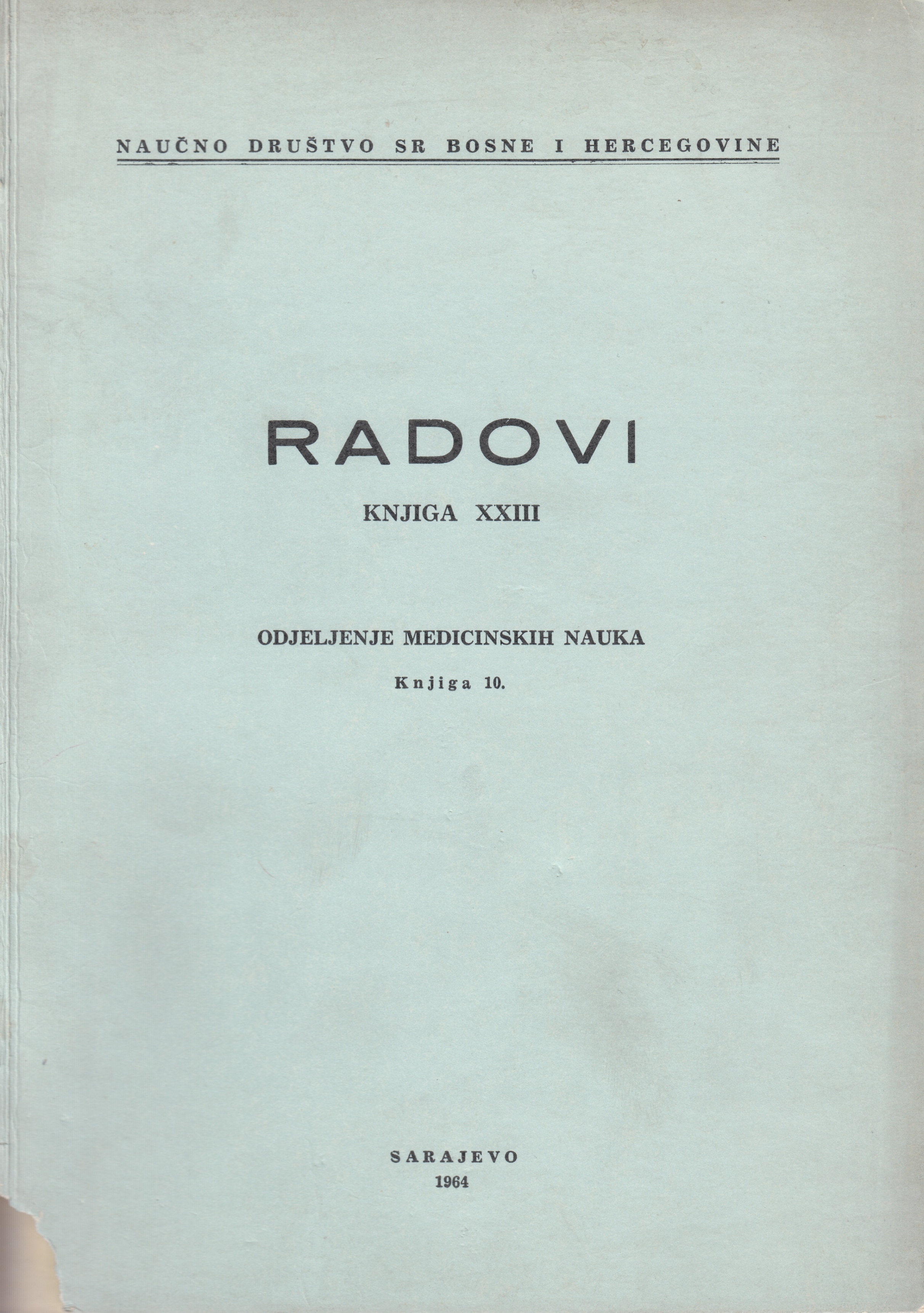
Endemijske treponematoze i njihovi međusobni odnosi
DOI:
https://doi.org/10.5644/Radovi.80Abstract
Infekcije uzrokovane treponemama, koje nose zajednički termin treponematoze, obuhvataju, s jedne strane, sporadični sifilis kao verično oboljenje, a s druge strane, endemijske treponematoze sa pretežno ekstragenitalnim infekcijama, kojima pripadaju frambezija, pinta i endemijski sifilis sa različitim lokalnim nazivima, kao „bejel“ u Iraku i Siriji, „njovera“ u Južnoj Rodeziji, „decucva“ u Becuanalandu, „siti“ u Gambiji, i drugim imenima. Slična oboljenja bila su raširena i u Evropi u XVII, XVIII i XIX vijeku, poznata pod imenom „sibens“ u Škotskoj, „radesige“ u Norveškoj, „škerljevo“ u Hrvatskom primorju i „frenjak“ ili „frenga“ još donedavno u Bosni i Hercegovini i nekim predjelima Srbije i Crne Gore.
References
Akrawi, F.: Brit. J. Vencr. D:s. 25, 115, 1919.
Akrawi, F.: Trans. Roy. Soc. Trop. Med. Hyg., 46, 77, 1952.
Bonetić, N.: Morbus Skerljcvo, Zagreb, 1936.
Brown, W. H., i Pearco, L.: J. Exp. Med. 33, 553, 1921.
Butler, C. S. i Peterson, E.: J. Lnb. Clin. Mod. 12, 670, 1927.
Butler, C. S.: Arch. Derm. Syph. 32. 446, 1935.
Butler, C. S.: Syphilis Sive Morbus Humanus, Lancaster, Pa. 1936.
Chesney, A. M.: Immunity in Syphilis, Baltimcre, Mđ. 1927.
Chesney, A. M. : Komp, J. E.: J. Exp. Med. 44, 589, 1926.
Fingor, E. i Landsteinor,: Handbuch der Geschlechtskrankheiten, Wien i Leipzig, 1912.
Fleger, J.: Med. Rev. Beograd, 5, 4, 1926.
Grin, E. L: Liječ. Vjesnik, 11, 131, 1928.
Grin, E. I.: Urol. Čulan. Rov., 39, 482, 1935.
Grin, E. I.i L:joc. Vjesn.k, 3, C0, 1238.
Grin, E. I.: Lijoč. Vjesnik, 61. 230, 1939.
Grin, E. L: Liječ. Vjesnik, 4, G2, 1940.
Grin, E. I.: Epidemiolcgy and Control of Endemic Syphilis. WHO, Monograph, Series No. 11. 1953.
Grin, E. I.: The Thailand Troponematoses Control Project. Progress Report, WHO.
Grin, E. I.: Buli. World, Hlth. Org., 15, 955, 1956.
Grin, E. I.: Raport cn a Study Visit to Iraq in connection with the Bejel Campaign. WHO. 1956.
Grin, E. I.: Buli. V/orld, Hlth. Org. 24, 229, 1931.
Grin, E. I.: St. John Hosp. Dermat. Tirmsact. 1962.
Gron, K.: u Jadassohn Handbuch der Haui- und Geochlechtskrankheiten, Berlin, 17, 283, 1928.
Guthe, T. i Willcox, R. R.: Chron. Wld. Hlth. Org. 8, 37, 1954.
Hackett, C. J.: Trans. R. S. Trop. Med. Hyg. 40, 206, 1946.
Hackett, C. J.: Bone Lesions of Yaws in Uganda. Oxford, 1951.
Hasselmann, C. M.: Arch. Derm. Syph. (Chicago) 66, 107, 1952.
Hasselmann, C. M.: Brit. J. Ven. D.s. 33, 1, 1957.
Hill K. R.: Non-specific factors in the epidom.iology of yaws. In: First Internatioal Symposium on Yaws Control, Geneva, WHO, Monograph Series, No. 15, 1953.
ILudson, E. H.: Treponematos.s, New York, 1946.
Hudson, E. H.: Non-Venereal Syphilis. Edinburgh, 1958.
Klokke, A. H.: Yav/s in the Housoholds of Tjav/as (Central Java) Surabaya, 1956.
Kranendonk, O.: Sorological and epidemiological aspects in Yaws Control, Amsterdam, 1958.
Luger, A.: Derm. Wschr. 137, 25, 1058.
Marquez, Fr.: WHO. Doc. VDT/222, 1956.
Murray, J. F. i dr.: Mod. 111 (London) 6, 407, 1952.
Murray, J. F. i dr.: Bull. World Hlth. Org., 15, 975, 1956.
S eho bi, O. i Hasselmann, C. M.: Arch. Schiff. — u. Tropenhyg. 36, 109, 1932.
Turner, T. B. i Hollander, D. H.: Buli. Wld. Hlth. Org. 7, 75, 1952.
Tucner, T. B. i Hollander, D. H.: Biology of Treponomatoses. WHO, Monograph Series No. 35, 1957.
Varala, G.: The Epidemiology of Pinta. WHO, Doc. VDT/190, 1955.
Vuletić, A., ed.: Endem:jski sifilis u Bosni i Hercegovini. Zagreb, 1939
Willcox, R. R.: Lancet, 1, 558, 1951.
Willcox, R. R.: Centr. Afr. Med. J., 1, 30, 1955.
Willcox, R. R.: Brit. J. Vener, Dis., 36, 78, 1960.
Zec, N.: Acta Med. lugoslav., 5, 176, 1951.
Downloads
Published
Issue
Section
License
Copyright (c) 2026 Ernest I. Grin

This work is licensed under a Creative Commons Attribution 4.0 International License.